
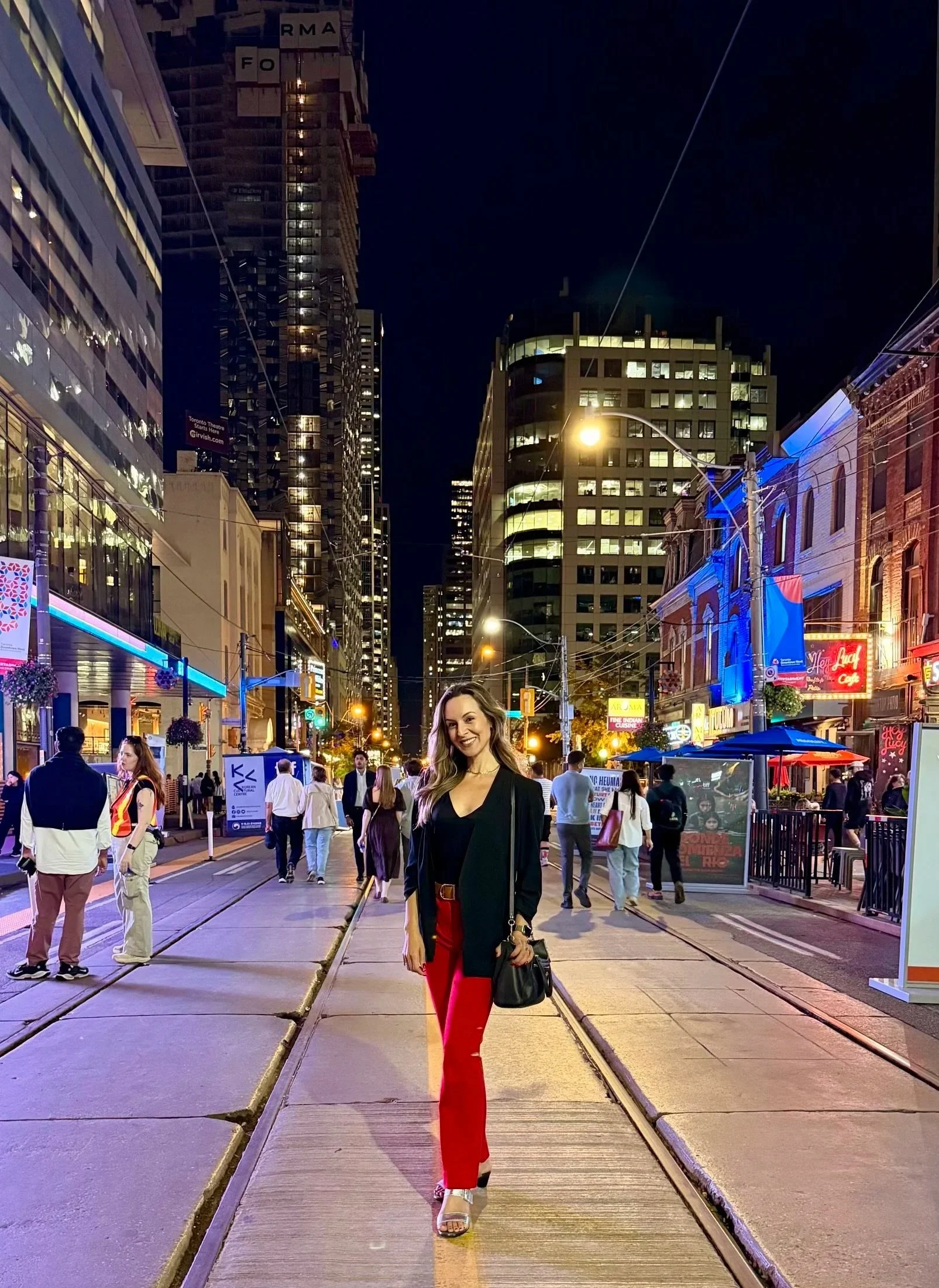
For one week in September, TIFF, the Toronto International Film Festival takes over our city and I get to become a tourist in my own town, looking for great love stories. Then I sit in the dark with others and get my heart broken, over and over.
I seek these films out because they take me inside the psychology of romantic love, and the people I work with, and because I want to keep understanding love from different perspectives.
This year, I saw nine films, seven of them about romantic love. And a common theme I noticed was that many of the romances I saw touched on romantic myths: the nice guy, destiny, the one, happily ever after.
Here are the six films I saw:
Everybody Wants to F*ck Me: What is "predatory dating"?
Director Jonathan Schey, United Kingdom | World premiere
Taron Egerton plays Adam, the performative “nice guy ” who seduces women by emotionally coercing them into falling for him. He uses niceness the way other men use charm, to emotionally coerce a woman into opening up. He quickly loses interest (often after they’ve had sex) or ghosts these women, until one strange evening every woman near him becomes dangerously attracted to him.
In the Q&A after the film, I heard the phrase "predatory dating" for the first time, and it really stood out to me. It's disturbing because it names something we already know is happening, then flips the script on who we picture doing it. It’s not the f-boy, or the conventionally attractive guy who gets by on looks. It’s the sensitive one, the one you tell your friends is different.
Watching the film, I was so sure a woman had written it. I was pleasantly surprised it wasn’t. The Director Jonathan. Schey has said the film is his way of poking fun at "performative nice guys," and he built it partly out of his own dating life, after a comedian took his real dating-app profile apart on stage.
Robert Glover's book No More Mr. Nice Guy, which I recommend often, makes a similar point. Niceness offered with a motive is not true kindness, it’s a manipulative strategy.
It Will Happen Tonight: What if destiny shows up at the wrong time?
Director Nanni Moretti, Italy | North American premiere
I went in to this film expecting a sweet Italian rom-com. The host introduced this film saying it would make us rethink romantic destiny, and that it did!
In the film, Matteo is playing tennis with his brother when Greta wanders onto the court and stops to play a game. He falls in love on the spot, while she barely notices. Over the years they cross paths, and by the time they finally sit down together in a café, both of them are married to other people and have children.
Moretti calls this his first true love story, and he adapted it from a story collection called Hungry Heart. His own summary of the film is four words: love is a powerful thing.
What we got was the shadow side of that power. We love the idea of destiny, but we imagine it being neat. We meet “the one,” marry, settle down, done. But this film explores what happens when it strikes again after you've settled, when you have a spouse and children that need you. We romanticize destiny, but sometimes it can turn our lives and the lives of those around us upside down.
It's shot so beautifully that you can forget these two have become entangled in a betrayal. But I think that was by design.
My husband, Mr.T and I talked about this movie for hours, even days after the movie.
In my relationship coaching practice, I see cases like this regularly - infidelity, love triangles, jealousy, etc. Each story is completely unique in its complexity. It was why I eventually built a service around it called It's Complicated. It can be hard to find an objective, open minded ear when you need one.
Love of Your Life: what happens when you lose the one?
Director Rachel Morrison, United States | World premiere. In theatres October 7
Maya (Margaret Qualley) is a Boston emergency-room nurse who meets Charlie, a genuinely good man, and lets herself be loved. Early on, we see the pandemic from inside an emergency room.
Then Maya loses him to COVID-19. Watching Maya live through what came next, from the front lines, was the most disturbing sequence I saw at TIFF.
Then her grief takes her to Portugal. The Guardian called the film "Eat, Grieve, Love," and it’s not wrong. As someone who loved the original “Eat, Pray, Love” I appreciated seeing her in a beautiful place, with beautiful food and wine, while her internal world is painful and dark.
For years helping people though the heartbreak of an ended relationship, I have heard this sentiment time and again. My clients have told me, "Natalia, I don't mean to be dramatic, but it feels like someone died." They are not being dramatic, and I know exactly what they mean.
While I understand that a breakup or a divorce isn’t death, but the loss is a form of grief (what I have called breakup grief for years). Some people have even told me they feel a breakup is even worse than a death, because the person is alive but rejecting them, and possibly with someone else.
I also heard three lines in this film that made me fall in love with it:
Catherine Keener's character: "Grief is never finished. But neither is love."
"I know you've already met the love of your life, but who's to say you can't have another?"
"You have to stay in love with your life while it's happening." Qualley herself describes the film as being about falling in love with your life.
Ha-Chan, Shake Your Booty!: Can a widow be in an open relationship with her late husband?
Director Josef Kubota Wladyka, United States
Haru and her Mexican husband Luis are ballroom partners in Tokyo. Then Luis dies.
Months later her cousin and friend coax her back to the dance studio, where the new instructor catches her eye. One night, over a casual dinner after a dance class he mentions he is in an open marriage. She tells him she is in one too.
In the theatre, that line got a laugh but it was also quite profound. While Haru was beginning to open up to someone new, a big part of her heart was still connected to her deceased husband.
This is the best-reviewed film of the six, with critics calling it "a lively exorcism of grief." Styleistically the film is magical realism, so grief shows up as visions, as levitation, as dance numbers in the street, and as a great deal of comedy, which surprised me. I think the director did an amazing job of bringing levity and beautifully comedic moments to highlight the messiness of grief.
In the Q&A I learned that the director Josef based the film on his mother, who is 82 and still competing in ballroom. She raised three boys on her own, and has said dancing is what got her through. She told her sons that no matter how difficult life gets, never stop dancing. She was in the theatre the night I saw it, and when he said so she stood up and waved.
Whatcha Want & Happily Ever After: Who actually gets to choose?
Two of the films had a common thread. They were not about the choice to leave, but the ability to make a choice at all.
Whatcha Want (director Mina Shum, Canada) follows Yin, a young woman from Hong Kong whose wealthy husband brings her to Vancouver as his wife and, in Shum's own words, in "the age-old tradition of mistresses," then goes back to work in Asia while she stays behind. Shum says she refused to make "the broccoli version" of this story and chose "a joyful empowerment movie inside something that's dark." It is light, and yes, at times a little Hallmark.
But the dark thing underneath is real - if Yin leaves, she leaves with nothing and is forced to return home to China.
As someone who supports people to decide and leave relationships that are over, this film made me sympathize with the ones who can't.
Then Happily Ever After (director Feng-I Fiona Roan), was about two sisters in Taiwan, a country I called home for four years. The older sister, Claire, resists everything marriage represents while he younger one, Kitty is heading into marriage with her eyes open, choosing it, knowing it may not be her happy ending.
Each of them is boxed in by their socio-economic status, family duty and cultural expectation.
At one point, Claire tells Kitty she’s worried she may not get her happy ever after. To which Kitty says, it's okay. If she doesn't get her happy ending, she'll make her own.
I thought that line was brilliant. Our happiness does not have to be external. It can be a choice, and we can find it in our own ways.
Roan has said she wants people to walk out asking what it means to be happy on their own terms, and in the Q&A she said we rarely question happiness.
What TIFF Taught Me About Love This Year
Heartbreak, grief, complicated love, choices made under pressure. Those are not what happens when love fails, it’s what love is made of.
I go to TIFF to immerse myself in love stories from around the world. To be reminded, once a year, that there are more ways to live and to love than I’ll ever know.
Thank you for reading, and until next year!
Believe in love,
Natalia
Would you like to discuss working through your breakup with dignity?
Natalia Juarez | Breakup & Relationship Coach
Natalia Juarez is a breakup coach and dating strategist. After going through a broken engagement in 2010, she became obsessed with reimagining heartbreak as an opportunity for transformation. Today, she helps men and women through the entire spectrum of breakups or divorce—helping them recover, initiate a separation, win an ex back, and find new love.
She's been featured in publications worldwide, including Good Morning America, The Wall Street Journal, GQ, The Guardian, Vice Media, NPR, among major Canadian media.